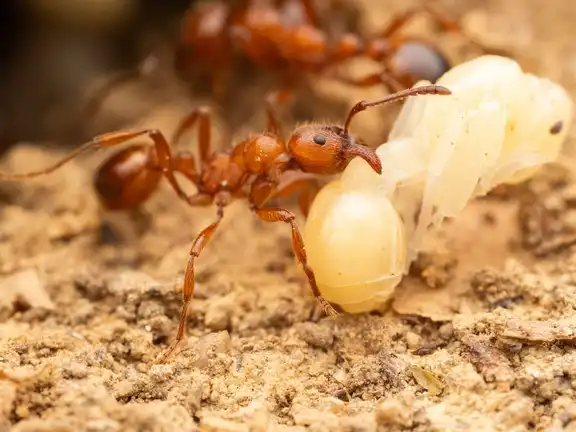
Manica rubida
DifficultyAdvanced · 7/7
Species comparison
Side by side: difficulty, size, growth, climate, hibernation and nuptial flights, from the data and sources of each species sheet.
| Manica rubida | Fact | Myrmica rubra |
|---|---|---|
| Keeping | ||
| Difficulty | ||
7/7 Advanced | Difficulty | Easier5/7 Intermediate |
| Escape risk | ||
Medium | Escape risk | Medium |
| Diet | ||
SugarInsects | Diet | SugarInsects |
| Best nests | ||
Ytong nest · Naturalistic setup · Test tube setup | Best nests | Ytong nest · Naturalistic setup · Sandwich nest |
| Colony | ||
| Growth | ||
Fast | Growth | Fast |
| Colony size | ||
Reaches 3,000 workers | Colony size | Reaches 10,000 workers |
| Workers | ||
5–9 mm All the same size | Workers | 4–6 mm All the same size |
| Queen | ||
10–13 mm | Queen | 5–7 mm |
| Colony founding | ||
Semi-claustral One or more queens | Colony founding | Semi-claustral Several queens |
| Defense | ||
Bites · Painful sting | Defense | Bites · Stings |
| Climate | ||
| Nest temperature | ||
20–28 °C | Nest temperature | 18–25 °C |
| Nest humidity | ||
50–70 % | Nest humidity | 50–70 % |
| Hibernation | ||
5–10 °C Oct – Mar | Hibernation | 5–8 °C Oct – Mar |
| Nuptial flights | ||
Apr – Jun Hot days | Nuptial flights | Aug – Sep Calm weather |
| Native range | ||
Europe, Middle East | Native range | Europe, Asia |
Manica rubida
Myrmica rubra
Manica rubida : Hibernation: Oct – Mar, Nuptial flights: Apr – Jun
Myrmica rubra : Hibernation: Oct – Mar, Nuptial flights: Aug – Sep
Months for temperate Europe and the Mediterranean. The weather decides the exact days, so flights can come earlier or later where you live.
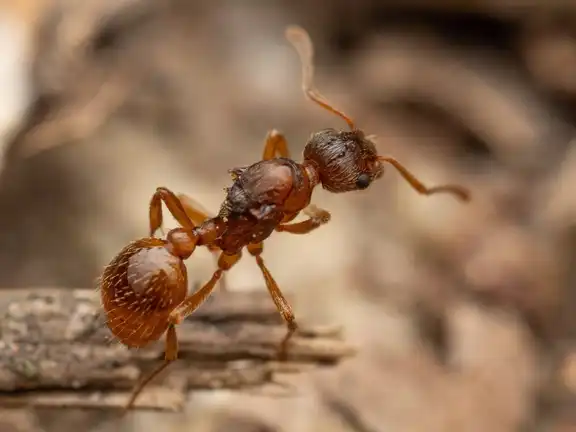
Large, slender workers in amber to reddish-brown with a darker head and a very shiny gaster that is darker at the rear; they look like oversized Myrmica but have no long spines on the back of the thorax. The excavated soil is piled into a crater around the nest entrance, which also gives a colony away in the field.
Reddish-brown to rusty-red workers with a darker head, a shiny gaster and two sharp spines on the back of the thorax. They are easy to mix up with other Myrmica such as Myrmica ruginodis, M. scabrinodis and M. sabuleti, so a sure species ID usually needs a microscope, and the queen is only a little bigger than a worker.
Take the 1-minute species finder quiz and get matched with the perfect species for your experience, your space and what you'd love to watch.