Semi-Claustral Founding
Definition
A way of starting a colony in which the newly mated queen cannot rely only on her body reserves and has to leave her chamber to forage for food while raising her first workers.
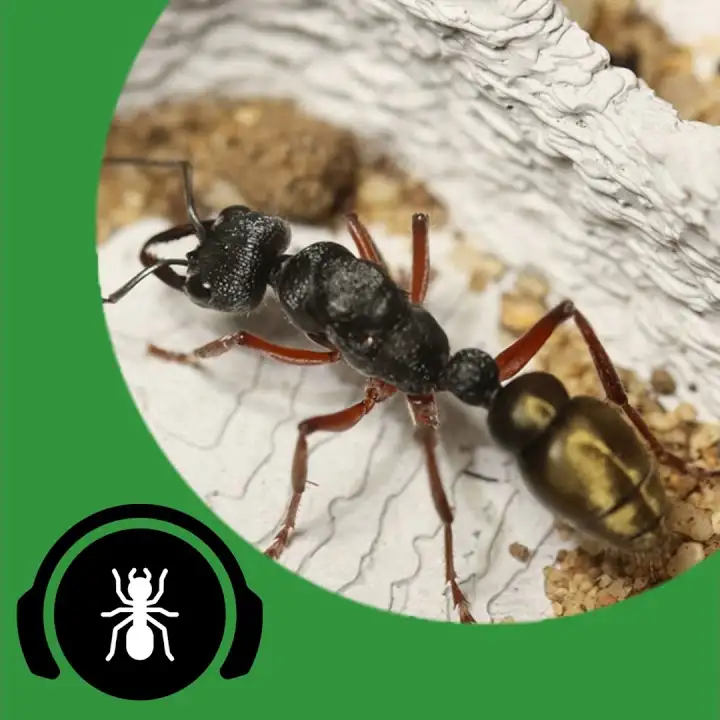
In semi-claustral founding, the queen doesn't have enough stored reserves to raise her first workers alone. After the nuptial flight she digs a small chamber, just like a claustral queen, but she has to leave it regularly to hunt or forage, bringing back food for herself and her larvae.
You can often guess the type by looking at the queen. Semi-claustral queens usually have a smaller, thinner gaster compared to the round, voluminous one of fully claustral queens. Species from genera like Myrmica, Manica and Myrmecia found this way, and in our Ant Pod episode on the topic, Lynn shares her experiences with Manica rubida and Myrmica rubra.
This style of founding is riskier, both in nature and in captivity. Every trip outside is dangerous for the queen, and in a setup she depends completely on you for food from day one. That's why the founding stage is where many semi-claustral colonies are lost.
In practice
- Start feeding a semi-claustral queen right away with small amounts of protein, like pieces of fruit flies or crickets, plus a little sugar.
- Give her a test tube connected to a small outworld, so she can come out to eat without being disturbed inside.
- Remove leftovers quickly. In such a tiny space, uneaten insects can grow mold fast.
- If you're not sure whether your queen is claustral, it's safer to treat her as semi-claustral.