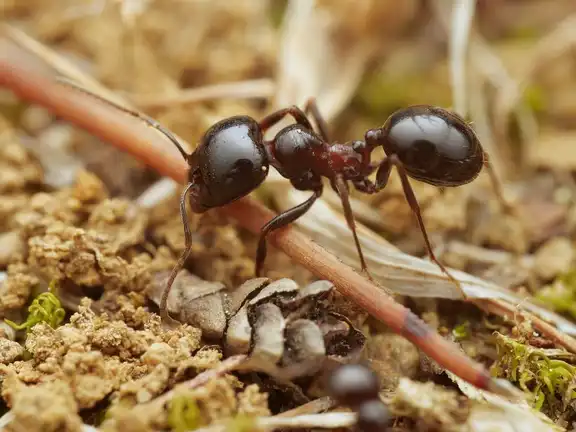
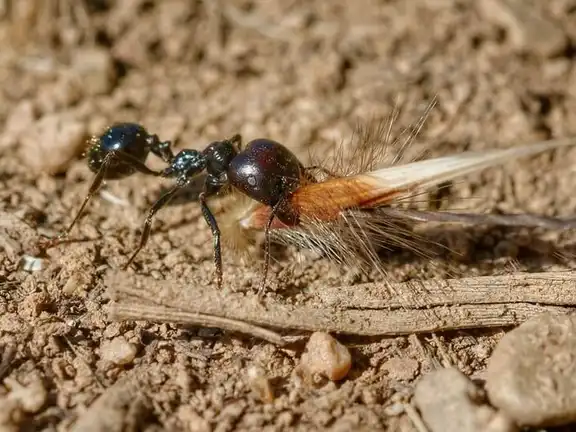
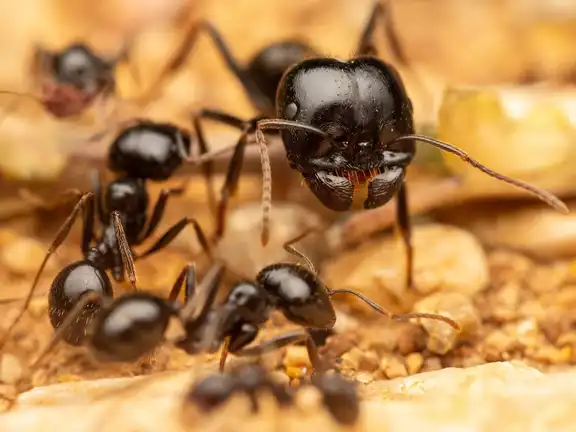
Messor ebeninus
Santschi, 1927
Ebony harvester ant
A glossy ebony-black harvester ant of the Middle East that stores its seeds upstairs and raises its brood in damp soil far below.
Compiled from published sources and keeper reports: I haven't kept this species myself, so treat the care values as starting points.
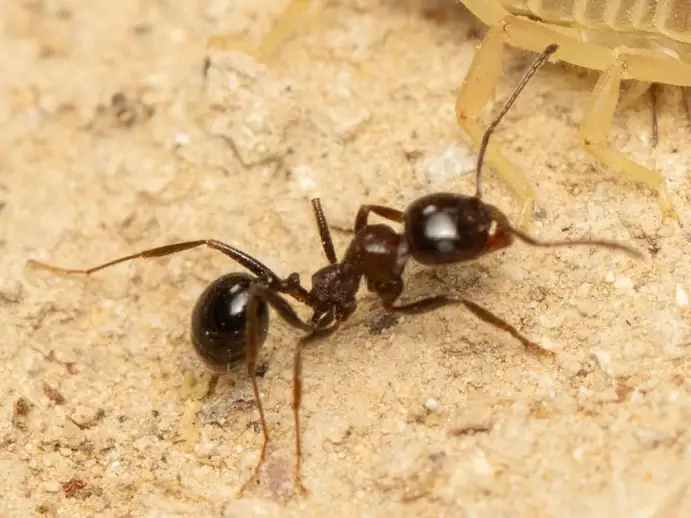
At a glance
- Nest temperature
- ≈ 22–28 °CIn the nest
- Nest humidity
- ≈ 50–60 %Seed granaries: 30–50 %
- Hibernation
- ≈ 15–18 °CJan – Feb · recommended
- Nuptial flights
- Nov – DecMorning flights
- Workers
- ≈ 4–8 mmmajors up to 10 mm
- Queen
- ≈ 11–12 mmOne queen
- Colony size
- ≈ Reaches 5,000 workersGrowth: Moderate
- Escape risk
- LowCalm ants that rarely try to escape
Year at a glance
Hibernation : Jan – Feb
Active season : Mar – Dec
Nuptial flights : Nov – Dec
- Morning flights
- After rain
Months in the native range of the species. The weather decides the exact days, and colonies kept indoors can follow a different rhythm.
How to recognize it
Shiny, evenly black workers of several sizes, with at most a slightly reddish thorax in the smallest ones, which sets them apart from the red-headed majors of Messor barbarus. Middle Eastern Messor are hard to tell apart even for specialists and shops often write cf., so this sheet follows the black form sold as ebeninus.
Often confused with
- Messor semirufus
- Messor capitatus
- Workers4–8 mm
- Majors≤ 10 mm
- Queen11–12 mm
mm
Biology
- Queens
- One queenEach colony has a single queen: never put two queens together once the first workers arrive.In the glossary
- Colony founding
- Fully claustralThe queen raises her first workers without eating, living off her wing muscles and fat reserves.In the glossary
- Workers
- Many sizesThe workers come in a continuous range of sizes, from small minors to large majors.In the glossary
- Defense
- BitesNo sting: the workers defend the colony by biting.
Native range
- Middle East
- North Africa
Bahrain, Egypt, Iran, Iraq, Israel, Kuwait, Lebanon, Oman, Saudi Arabia, Syria, Türkiye, United Arab Emirates
Taxonomy
Myrmicinae › Stenammini
Messor
Care at a glance
Difficulty
Why this rating
- Makes it easier: Calm workers that rarely try to escape
- Makes it easier: Fully claustral: the queen needs no food until her first workers arrive
- Makes it easier: Stores seeds, so a missed feeding is not a problem
- Makes it harder: Needs a humidity gradient, with dry granaries and humid brood chambers
Food
- Seeds
- Insects
- Sugar
A seed harvester: seeds can feed the whole colony, with insects and sugar as extras.
Best nests
- 1Ytong nest
- 2Acrylic nest
- 3Naturalistic setup
Notes from keepers
Tip
Copy the two floors of the wild nest: a dry upper part for the seed store and a damp lower part for the queen and brood. In a Ytong or plaster nest, water only one end and leave the other end dry.
Tip
Start the first workers on very small, soft seeds. In a rearing study of wild queens in Lebanon, the first workers ignored big, tough legume seeds and sugary food, and early colonies failed for lack of suitable seeds until tiny seeds of the geranium family were offered.
Watch out
A queen caught after the autumn flight lays only in late winter, so a tube without eggs for months is normal. A young colony then grows slowly: in that study it had only a few dozen workers by the next autumn.
Watch out
Open water is a drowning trap for Messor, so cover water spots with small stones or cotton. Feed the seeds in the outworld only and remove leftovers before they mold.
Related posts

How To Make a Test Tube Setup - Ant Keeping Basics
In this tutorial you will learn how to make a test tube setup, the best way to create the optimal environment for a newly mated queen ant!
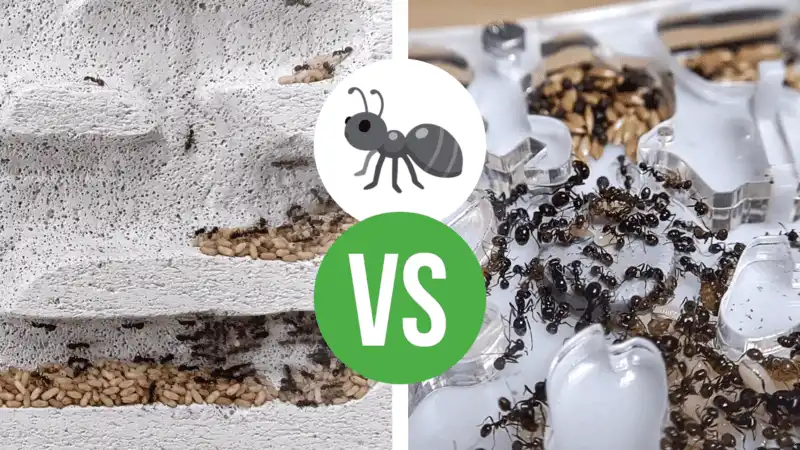
Ytong vs Acrylic - Which Is Better For An Ant Nest?
In this article, we’re going to talk about two of the most popular types of ant nests: acrylic nests and Ytong nests! Let's compare them!

How To Hibernate Your Ants - Hibernation Tutorial
In this guide, we’re going to talk about hibernation: What is it? Why do ants need hibernation? Should I hibernate my ants? Let's see!
FAQs
9It started out as one: Santschi described it in 1927 as a variety of Messor semirufus, and it was raised to a species later. A 2023 preprint on the harvester ants of Israel found that ebeninus forms its own genetic lineage and is the most widespread Messor in the country, but also that some ants identified as semirufus with the usual morphological keys turned out to be ebeninus. That is one reason why shops often write cf. in the name.
A study of the nest in the early 1970s describes a deep main shaft with chambers and side galleries, split into two levels. The upper level stays dry in summer and works as a granary, while the lower level reaches down to the edge of the water table and shelters the queen and the brood. Experiments showed that the queen and the workers dig in the damp parts of the soil, and that the long, hot, dry summer drives the colony to deeper, moister layers.
Messor ebeninus workers measure 4–8 mm, with majors up to 10 mm, and the queen measures 11–12 mm.
Just one. Messor ebeninus is monogyne: each colony has a single queen, so never put two queens together once the first workers arrive.
No. Messor ebeninus cannot sting: the workers defend the colony by biting.
In its native range, Messor ebeninus usually flies in Nov – Dec. The weather decides the exact days.
Keep the Messor ebeninus nest at 22–28 °C, with 50–60 % humidity in the brood chambers.
Not strictly, but it helps. A cooler winter rest at 15–18 °C, roughly during Jan – Feb, keeps Messor ebeninus colonies healthy.
Messor ebeninus is not on the EU list of invasive alien species and is not protected in the countries we checked. Rules differ between countries and can change, so check your local laws first.
Sources and review
- 1
- 2
- 3
- 4
- 5
Showing 5 of 19 sources
Last reviewed
- BiologyKeeper consensus
- Care valuesFew sources
- Nuptial flightsKeeper consensus
Legal status
Not on the EU list of invasive alien species and not protected in the countries we checked. Rules differ between countries and can change, so check your local laws before buying or collecting a queen.
Checked on October 11, 2026
All values are starting points: watch your colony and adjust. Found something wrong or missing?
Suggest a correction