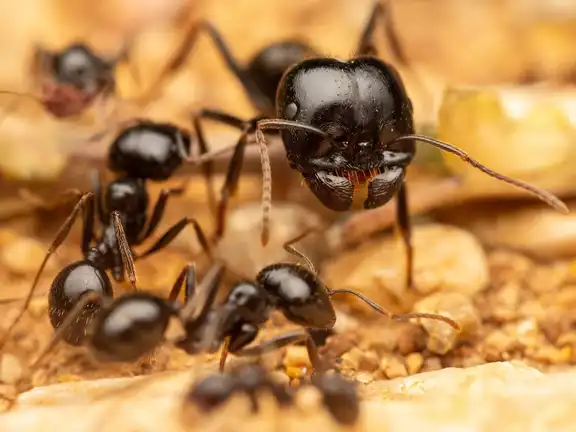
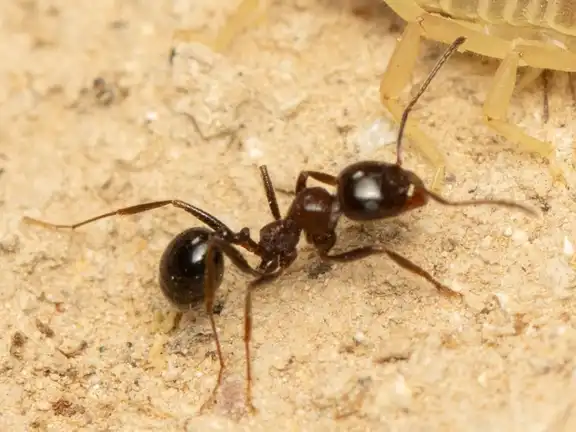
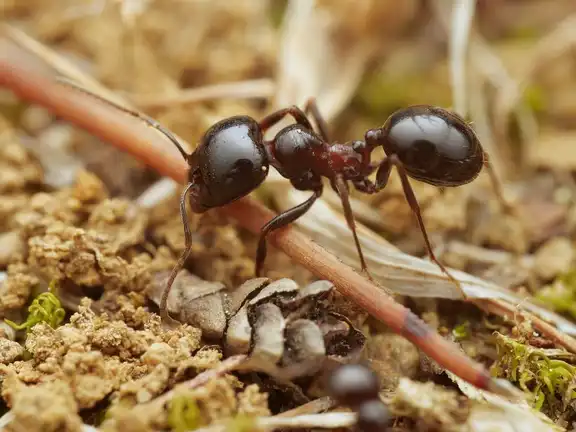
Messor structor
(Latreille, 1798)
A rough-skinned brown harvester ant that shares its nest with many queens and spreads by splitting off new colonies.
Compiled from published sources and keeper reports: I haven't kept this species myself, so treat the care values as starting points.
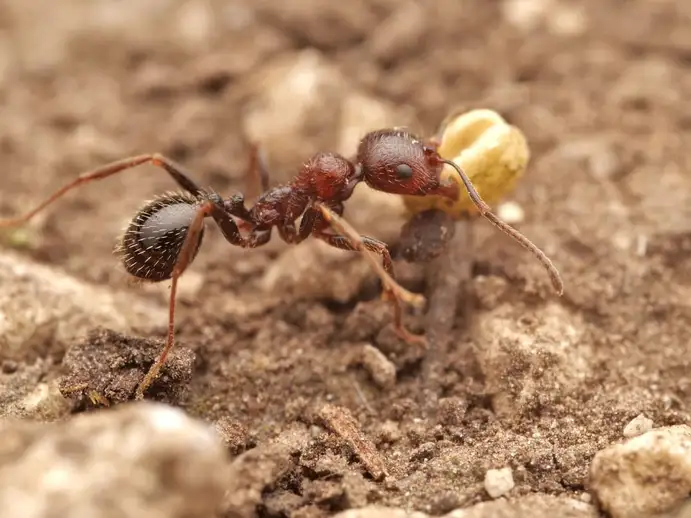
At a glance
- Nest temperature
- 22–28 °CIn the nest
- Nest humidity
- ≈ 50–70 %Seed granaries: 30–50 %
- Hibernation
- ≈ 8–12 °CNov – Feb
- Nuptial flights
- ≈ Apr – Jun
- Workers
- ≈ 4–8 mmmajors up to 10 mm
- Queen
- ≈ 9–11 mmSeveral queens
- Colony size
- ≈ Reaches 5,000 workersGrowth: Fast
- Escape risk
- LowCalm ants that rarely try to escape
Year at a glance
Hibernation : Nov – Feb
Active season : Mar – Oct
Nuptial flights : Apr – Jun
Months for temperate Europe and the Mediterranean. The weather decides the exact days, so flights can come earlier or later where you live.
How to recognize it
Light to dark brown workers of many sizes, sometimes nearly black, with abundant hairs and a coarse, striated surface that looks duller than the glossy black Messor capitatus. Since 2018 the name covers only one of five species once lumped together, and ants collected around the Mediterranean and sold as structor are very likely Messor ibericus, which is hard to tell apart without measurements under a microscope but is kept the same way.
Often confused with
- Messor ibericus
- Messor barbarus
- Messor capitatus
- Workers4–8 mm
- Majors≤ 10 mm
- Queen9–11 mm
mm
Biology
- Queens
- Several queensColonies live with several queens, which helps them grow faster.In the glossary
- Colony founding
- Fully claustralThe queen raises her first workers without eating, living off her wing muscles and fat reserves.In the glossary
- Workers
- Many sizesThe workers come in a continuous range of sizes, from small minors to large majors.In the glossary
- Defense
- BitesNo sting: the workers defend the colony by biting.
Native range
- Europe
Austria, Bulgaria, Czechia, France, Hungary, Romania, Slovakia, Slovenia
Taxonomy
Myrmicinae › Stenammini
Messor
Care at a glance
Difficulty
Why this rating
- Makes it easier: Calm workers that rarely try to escape
- Makes it easier: Fully claustral: the queen needs no food until her first workers arrive
- Makes it easier: Stores seeds, so a missed feeding is not a problem
- Makes it harder: Needs a humidity gradient, with dry granaries and humid brood chambers
Food
- Seeds
- Insects
- Sugar
A seed harvester: seeds can feed the whole colony, with insects and sugar as extras.
Best nests
- 1Ytong nest
- 2Acrylic nest
- 3Naturalistic setup
Notes from keepers
Tip
Start with a queen that comes with workers, or put several queens together. French keepers report that lone queens often fail to found a colony in captivity, because the species seems to start new nests mostly by budding.
Tip
Offer dead insects and very ripe sweet fruit next to the seeds. French keepers say it needs them more than other harvester ants do, Italian keepers note a liking for sweet fruit, and honey is often ignored.
Watch out
The workers dig into aerated concrete and plaster, mostly when they run short of space. Coat a Ytong nest with mortar, tile glue or resin plaster, or use acrylic, and never leave thin walls.
Watch out
A damp nest full of rotting seeds is ideal for detritivorous mites. Laying stops, activity drops and the brood disappears, so keep one dry zone for storing seeds, freeze seeds and insects before feeding, and remove spoiled seeds.
Related posts

How To Hibernate Your Ants - Hibernation Tutorial
In this guide, we’re going to talk about hibernation: What is it? Why do ants need hibernation? Should I hibernate my ants? Let's see!
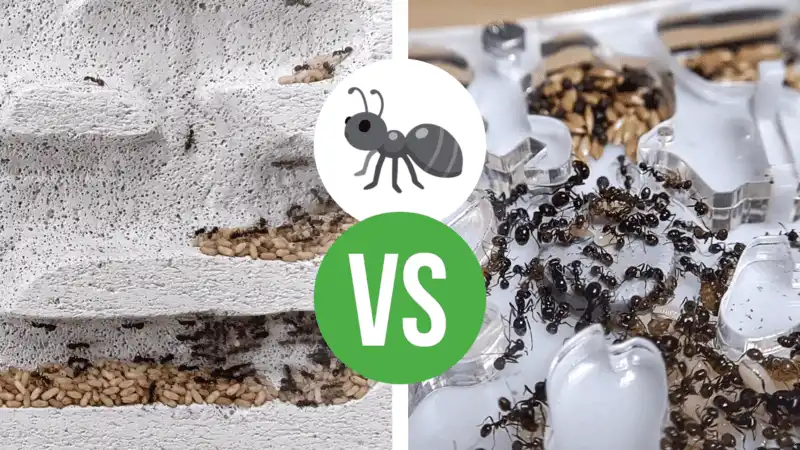
Ytong vs Acrylic - Which Is Better For An Ant Nest?
In this article, we’re going to talk about two of the most popular types of ant nests: acrylic nests and Ytong nests! Let's compare them!
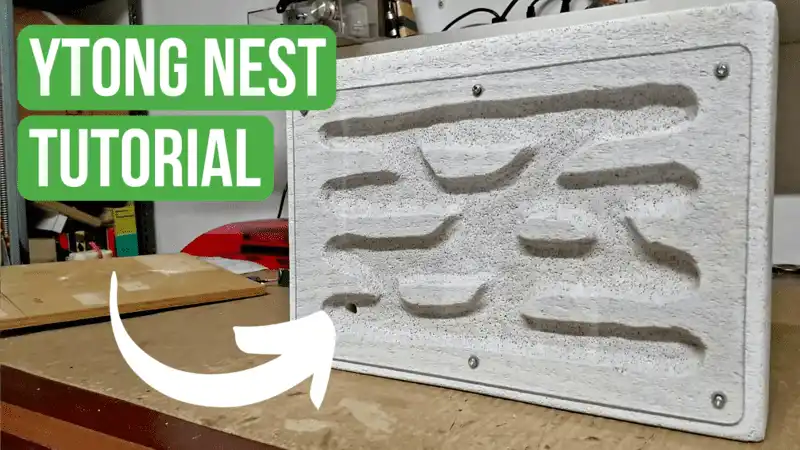
How To Make a Ytong Nest - Ant Keeping Tutorial
In this tutorial, you will learn how to make a Ytong nest for your ant colonies! This is one of the best nest types for many ant species!
FAQs
9No. In 2018 researchers split the old Messor structor into five species, and the name structor now covers the one living in Central Europe and parts of France. Messor ibericus lives around the Mediterranean, has smaller queens and differs in small details of the antennae, and a 2025 study in Nature showed that its queens clone Messor structor males and need their sperm to produce workers, so all its workers are hybrids. Keepers give both the same care.
Often by budding. After mating near or inside the nest, a queen either goes back into the colony or leaves with a group of workers to start a new nest nearby. In a Lower Austrian population no swarming flights were seen and ants from many nests lived together as one supercolony, while other populations are reported to swarm in spring.
Messor structor workers measure 4–8 mm, with majors up to 10 mm, and the queen measures 9–11 mm.
Several. Messor structor is polygyne: colonies live with more than one queen, which helps them grow faster.
No. Messor structor cannot sting: the workers defend the colony by biting.
In temperate Europe and the Mediterranean, Messor structor usually flies in Apr – Jun. The weather decides the exact days.
Keep the Messor structor nest at 22–28 °C, with 50–70 % humidity in the brood chambers.
Yes. Hibernate Messor structor at 8–12 °C, roughly during Nov – Feb.
Messor structor is not on the EU list of invasive alien species and is not protected in the countries we checked. Rules differ between countries and can change, so check your local laws first.
Sources and review
- 1
- 2Steiner et al. (2018), Molecular Phylogenetics and Evolution 127: Turning one into five, integrative taxonomy of the harvester ant Messor structor (redescription of M. structor and M. ibericus from morphometrics, mitochondrial DNA, AFLP, Wolbachia strains and ecological niche models)
Paper · Taxonomy, Biology, Distribution
- 3
- 4
- 5
Showing 5 of 28 sources
Last reviewed
- BiologyKeeper consensus
- Care valuesKeeper consensus
- Nuptial flightsFew sources
Legal status
Not on the EU list of invasive alien species and not protected in the countries we checked. Rules differ between countries and can change, so check your local laws before buying or collecting a queen.
Checked on October 11, 2026
All values are starting points: watch your colony and adjust. Found something wrong or missing?
Suggest a correction