Tetramorium immigrans
Santschi, 1927
Immigrant pavement ant
The common pavement ant of North American cities: tiny, tough and fast-growing, it fights mass battles on sidewalks in spring.
Compiled from published sources and keeper reports: I haven't kept this species myself, so treat the care values as starting points.
At a glance
- Nest temperature
- ≈ 22–28 °CIn the nest
- Nest humidity
- ≈ 40–60 %In the nest
- Hibernation
- ≈ 5–10 °CNov – Feb · recommended
- Nuptial flights
- ≈ May – JulMorning flights
- Workers
- 2.5–4 mmAll the same size
- Queen
- ≈ 7–8 mmOne queen
- Colony size
- ≈ Reaches 10,000 workersGrowth: Fast
- Escape risk
- HighEscape artists: use a closed outworld and a good barrier
Year at a glance
Hibernation : Nov – Feb
Active season : Mar – Oct
Nuptial flights : May – Jul
- Morning flights
- Calm weather
- Humid air
Months for temperate Europe and the Mediterranean. The weather decides the exact days, so flights can come earlier or later where you live.
How to recognize it
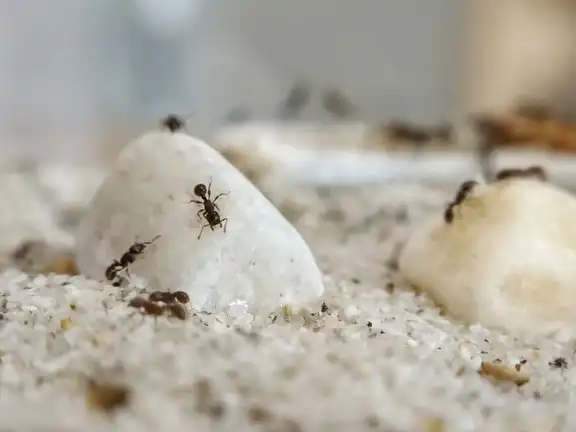
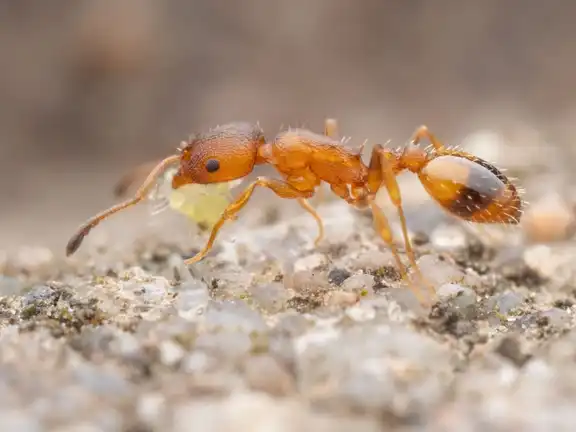
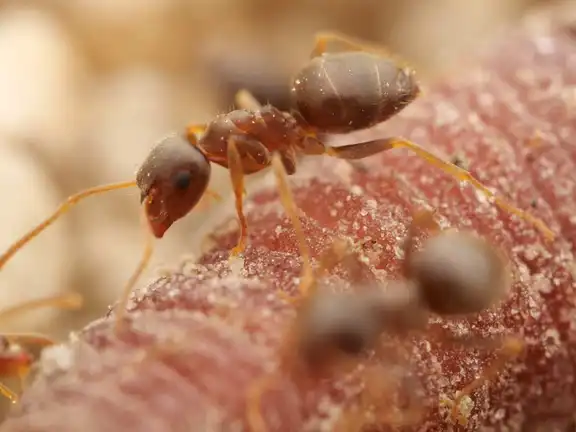
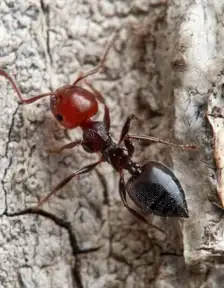
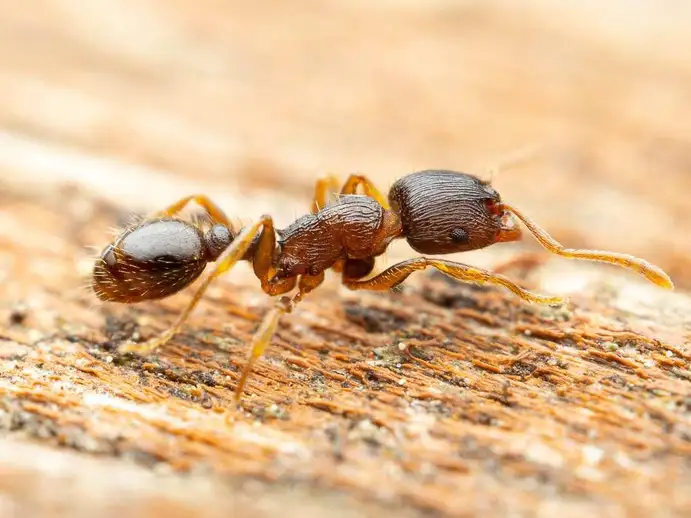
Small dark brown to blackish workers with fine parallel ridges on the head and thorax, two short spines at the back of the thorax and a two-segment waist, on average a little larger and more densely sculptured than Tetramorium caespitum. Telling it from T. caespitum or T. impurum takes measurements at 100x magnification or a look at the male genitalia, while the Japanese pavement ant T. tsushimae is slightly smaller with longer spines.
Often confused with
- Tetramorium caespitum
- Tetramorium impurum
- Tetramorium tsushimae
- Workers2.5–4 mm
- Queen7–8 mm
mm
Biology
- Queens
- One queenEach colony has a single queen: never put two queens together once the first workers arrive.In the glossary
- Colony founding
- Fully claustralThe queen raises her first workers without eating, living off her wing muscles and fat reserves.In the glossary
- Workers
- All the same sizeAll the workers have about the same size and shape.
- Defense
- Bites · StingsThe workers can sting. It is usually mild for people, but avoid handling them.
Native range
- Europe
- Middle East
Armenia, Azerbaijan, Russia, Türkiye
Taxonomy
Myrmicinae › Crematogastrini
Tetramorium
Care at a glance
Difficulty
Why this rating
- Makes it easier: Fully claustral: the queen needs no food until her first workers arrive
- Makes it easier: Stores seeds, so a missed feeding is not a problem
- Makes it harder: A real escape artist that needs an escape-proof setup
- Makes it harder: Colonies get huge and need room to expand
- Makes it harder: The workers can sting
Food
- Insects
- Sugar
- Seeds
A seed harvester: seeds can feed the whole colony, with insects and sugar as extras.
Best nests
Notes from keepers
Watch out
The workers are tiny and test every gap. One keeper saw Tetramorium eat an olive oil barrier, and another had workers slip through a small gap into a neighboring colony's setup, where they were killed at once. Use a tight lid, glue fine steel mesh over the vents and add a second barrier such as Fluon.
Watch out
Several queens kept together can found a nest as a group, but it does not last. In one keeper's five multi-queen groups the workers killed queens until one was left, and two groups ended with no queen at all, so keep one queen per tube.
Tip
Give the nest a moist end and a dry end, and warm one side only. Keepers report that the workers keep the eggs and larvae in the damp part and move the pupae and seeds to the drier part. In a test tube, heat only the end away from the water, because warming the water can make the tube flood.
Tip
Feed insects several times a week, keep sugar water available and add a few small seeds such as dandelion, poppy or grass seeds, which the workers collect and store. Remove leftovers within a day and do not give a small colony an oversized nest, because trash builds up in the unused chambers and mold follows.
Related posts
How To Care for Tetramorium caespitum
In this guide you will learn how to care for Tetramorium caespitum! Temperature, humidity, food, hibernation, nest type... and much more!
How To Make a Tubs & Tubes Setup
In this tutorial, you will learn how to make a tubs and tubes setup, the best way to create the optimal environment for your queen ant!
How To Hibernate Your Ants - Hibernation Tutorial
In this guide, we’re going to talk about hibernation: What is it? Why do ants need hibernation? Should I hibernate my ants? Let's see!
FAQs
10Not by eye. T. immigrans workers are on average the largest of these look-alikes, with more ridges behind the eyes and a stronger fine pattern on the first segment of the gaster, but telling them apart takes measurements at 100x magnification or more. Males differ in a small detail of their genitalia, and the two species can hybridize. Location helps: the common pavement ant of North America is T. immigrans, while in Britain and Fennoscandia only T. caespitum is recorded.
Neighboring colonies clash mostly in spring, and thousands of workers pair off and wrestle by gripping each other's jaws. These fights are largely ritual: staged battles lasted about 45 minutes on average, and only tens to about a hundred dead workers are found afterward, out of the thousands involved. Nobody knows yet why they fight. One idea, from the related Tetramorium tsushimae, is that colonies compete for warm ground where they raise their winged queens and males.
Its genetic diversity is highest in Anatolia and the Caucasus, which makes that region its most likely origin, and it seems long settled in the Balkans and the Pannonian Basin. In western Europe and much of central Europe it is a newcomer, found mostly in towns and cities. It reached North America by the late 1800s, and genetic work suggests that the North American ants descend from one or a few related colonies, now spread to at least 39 US states and 3 Canadian provinces. The specimens used to name it came from Valparaíso, Chile.
Tetramorium immigrans workers measure 2.5–4 mm, and the queen measures 7–8 mm.
Just one. Tetramorium immigrans is monogyne: each colony has a single queen, so never put two queens together once the first workers arrive.
Yes. Tetramorium immigrans workers can sting. It is usually mild for people, but it's best to avoid handling them.
In temperate Europe and the Mediterranean, Tetramorium immigrans usually flies in May – Jul. The weather decides the exact days.
Keep the Tetramorium immigrans nest at 22–28 °C, with 40–60 % humidity in the brood chambers.
Not strictly, but it helps. A cooler winter rest at 5–10 °C, roughly during Nov – Feb, keeps Tetramorium immigrans colonies healthy.
Tetramorium immigrans is not on the EU list of invasive alien species and is not protected in the countries we checked. Rules differ between countries and can change, so check your local laws first.
Sources and review
- 1Wagner, Arthofer, Seifert, Muster, Steiner and Schlick-Steiner (2017), Myrmecological News 25: Light at the end of the tunnel, integrative taxonomy delimits cryptic species in the Tetramorium caespitum complex (T. immigrans raised to species, largest and most densely sculptured workers of the complex, keys to workers at 100x magnification and to male genitalia, Anatolia and the Caucasus as the likely origin, adult sexuals in nests from March to September with a mean in late June)
Paper · Taxonomy, Biology, Distribution, Nuptial flights
- 2Moss, Swallow and Greene (2022), Myrmecological News 32: Always under foot, Tetramorium immigrans, a review (monogyne and claustral, flights from late May to July starting near sunrise on still days, seeds stored in late summer and autumn, ritual battles between colonies, spread through Europe and North America, keeper advice on moisture gradients)
Paper · Taxonomy, Biology, Distribution, Nuptial flights, Care
- 3
- 4
- 5
Showing 5 of 32 sources
Last reviewed
- BiologyKeeper consensus
- Care valuesKeeper consensus
- Nuptial flightsFew sources
Legal status
Not on the EU list of invasive alien species and not protected in the countries we checked. Rules differ between countries and can change, so check your local laws before buying or collecting a queen.
Checked on October 26, 2026
All values are starting points: watch your colony and adjust. Found something wrong or missing?
Suggest a correction