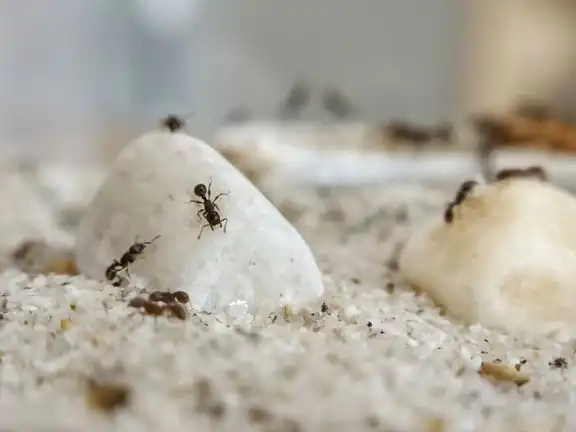
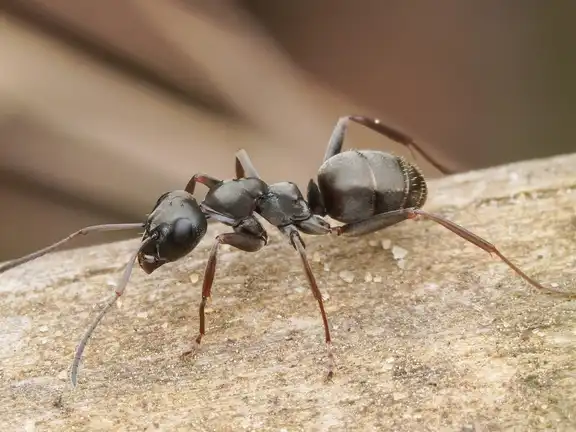
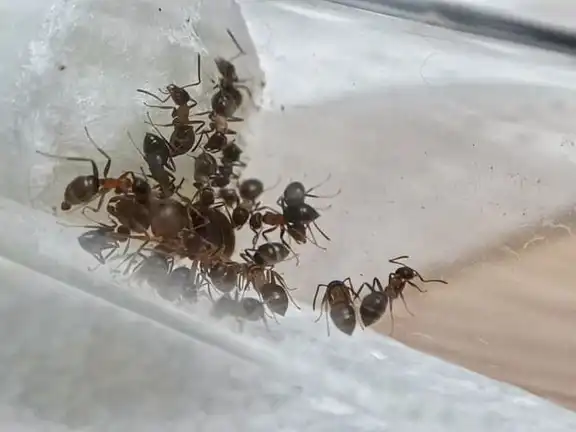
Temnothorax unifasciatus
(Latreille, 1798)
A tiny, peaceful ant with a dark band across its gaster, small enough that a whole colony can live inside an acorn.
Compiled from published sources and keeper reports: I haven't kept this species myself, so treat the care values as starting points.
At a glance
- Nest temperature
- 20–26 °CIn the nest
- Nest humidity
- 50–60 %In the nest
- Hibernation
- ≈ 5–10 °CNov – Mar
- Nuptial flights
- ≈ Jul – AugMorning flights
- Workers
- 2.5–3.5 mmAll the same size
- Queen
- 3.5–4.5 mmOne queen
- Colony size
- ≈ Reaches 200 workersGrowth: Moderate
- Escape risk
- MediumKeep an escape barrier on the outworld
Year at a glance
Hibernation : Nov – Mar
Active season : Apr – Oct
Nuptial flights : Jul – Aug
- Morning flights
Months for temperate Europe and the Mediterranean. The weather decides the exact days, so flights can come earlier or later where you live.
How to recognize it
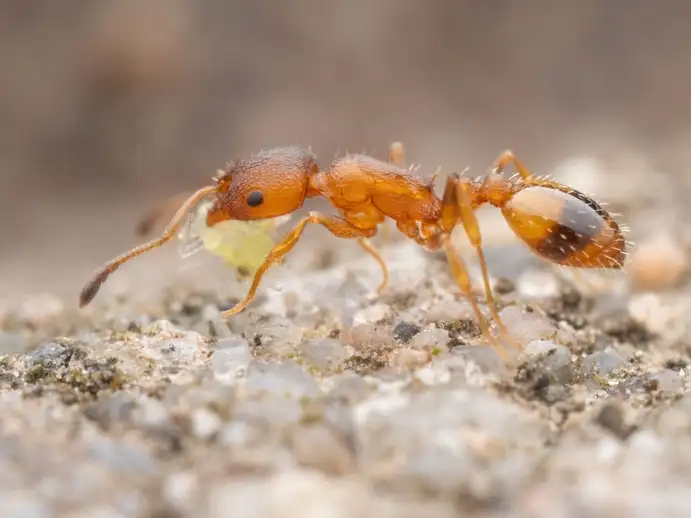
Tiny workers in yellowish to reddish brown, often with a darker head, and a sharply defined dark band across the gaster; the queen is only a little bigger and darker. The band separates it from look-alike Temnothorax such as T. nylanderi, T. tuberum and T. albipennis, but with so many similar small species, a colony sold under this name is worth checking under a magnifier.
Often confused with
- Temnothorax nylanderi
- Temnothorax tuberum
- Temnothorax albipennis
- Workers2.5–3.5 mm
- Queen3.5–4.5 mm
mm
Biology
- Queens
- One queenEach colony has a single queen: never put two queens together once the first workers arrive.In the glossary
- Colony founding
- Fully claustralThe queen raises her first workers without eating, living off her wing muscles and fat reserves.In the glossary
- Workers
- All the same sizeAll the workers have about the same size and shape.
- Defense
- Bites · StingsThe workers can sting. It is usually mild for people, but avoid handling them.
Native range
- Europe
- North Africa
- Middle East
Austria, Belgium, Bulgaria, Czechia, France, Germany, Greece, Hungary, Italy, Netherlands, Poland, Portugal, Spain, Switzerland, Türkiye
Taxonomy
Myrmicinae › Crematogastrini
Temnothorax
Care at a glance
Difficulty
Why this rating
- Makes it easier: Fully claustral: the queen needs no food until her first workers arrive
- Makes it harder: Curious workers: keep an escape barrier on the outworld
- Makes it harder: Needs a cold hibernation, for example in a fridge
- Makes it harder: The workers can sting
Food
- Sugar
- Insects
Sugar or honey water for the workers, and insects as protein for the queen and the brood.
Best nests
- 1Ytong nest
- 2Acrylic nest
- 3Naturalistic setup
Notes from keepers
Tip
Give them seasons instead of a constant warm room: keepers describe a hardy species that does better with cooler nights and a real winter rest. Just keep the nest itself from getting hot and soggy, because a sunny, damp setup cost one keeper about two dozen workers and several pupae.
Watch out
Never put out a free drop of honey or sugar water, because even a tiny drop can trap and drown a worker. Soak a piece of cotton in the liquid instead and replace it often.
Tip
Offer dead prey in small portions and cut hard-bodied insects open. The workers are not active hunters, but they slip into the joints of an insect, hollow it out and carry it to the brood, and keepers report fruit flies, small crickets and mealworm pieces being accepted.
Watch out
Escape-proof the setup for an ant this small, because the workers test every seam and gap, especially in the first weeks. Keepers combined fine metal mesh over the ventilation holes with a band of paraffin oil or an oil and petroleum jelly mix around the rim, and one found the oil barrier worked better than a mesh-only design.
Related posts

How To Hibernate Your Ants - Hibernation Tutorial
In this guide, we’re going to talk about hibernation: What is it? Why do ants need hibernation? Should I hibernate my ants? Let's see!
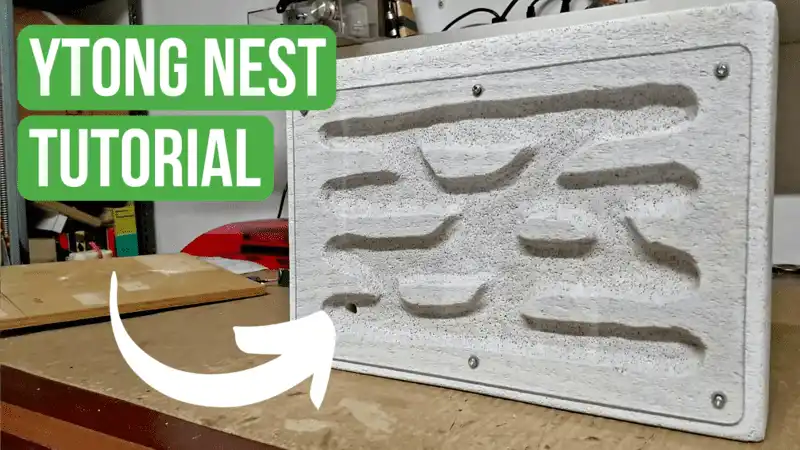
How To Make a Ytong Nest - Ant Keeping Tutorial
In this tutorial, you will learn how to make a Ytong nest for your ant colonies! This is one of the best nest types for many ant species!

How To Make a Test Tube Setup - Ant Keeping Basics
In this tutorial you will learn how to make a test tube setup, the best way to create the optimal environment for a newly mated queen ant!
FAQs
10It is a documented behavior of this species. In a study led by Jürgen Heinze, workers dying from a fungal infection, workers whose life had been cut short by carbon dioxide and workers dying naturally all left the nest and broke off contact with their nestmates days or hours before death. Because it happened whether or not the ants were infected, the researchers concluded that the disease is not steering them and that leaving probably protects the colony from infection. A lone dead worker far from the nest is therefore not necessarily a sign of trouble.
It nests in small cavities. In the wild it is usually found under flat stones warmed by the sun, in rock crevices, stone walls and stone heaps, less often under bark, in dead branches and in hollow plant stems, and a survey of oak galls in Tuscany found it nesting in galls on the trees. Colonies are small, at most a few hundred workers, so a gall, an acorn or a hollow nut is enough, and keepers note that Temnothorax feel at home in cramped chambers.
The colony cannot raise new workers without her. After a while a few dominant workers start laying unfertilized eggs, which can only become males, and if a queen comes back to such a colony the workers that became fertile are attacked. Adding a foreign queen is a long shot: one keeper had to separate her from a worker after two hours, and later attempts failed too. A colony that raises young queens of its own can recover, though. In a lab colony described in a German ant-conservation journal, a daughter queen mated inside the small nest and took over after the workers attacked the old queen in the colony's eleventh year in the lab. Digging up a wild colony can also kill its queen, as it did for one keeper within three days.
Temnothorax unifasciatus workers measure 2.5–3.5 mm, and the queen measures 3.5–4.5 mm.
Just one. Temnothorax unifasciatus is monogyne: each colony has a single queen, so never put two queens together once the first workers arrive.
Yes. Temnothorax unifasciatus workers can sting. It is usually mild for people, but it's best to avoid handling them.
In temperate Europe and the Mediterranean, Temnothorax unifasciatus usually flies in Jul – Aug. The weather decides the exact days.
Keep the Temnothorax unifasciatus nest at 20–26 °C, with 50–60 % humidity in the brood chambers.
Yes. Hibernate Temnothorax unifasciatus at 5–10 °C, roughly during Nov – Mar.
Temnothorax unifasciatus is not on the EU list of invasive alien species and is not protected in the countries we checked. Rules differ between countries and can change, so check your local laws first.
Sources and review
- 1Collingwood (1979), Fauna Entomologica Scandinavica 8: The Formicidae (Hymenoptera) of Fennoscandia and Denmark, treatment of Leptothorax unifasciatus (Plazi TreatmentBank)
Book · Taxonomy, Biology, Distribution, Nuptial flights
- 2BWARS (Bees, Wasps and Ants Recording Society): Temnothorax unifasciatus (identification, habitat, single queen, sexuals in July and August, mating flights at sunrise)
Reference · Biology, Distribution, Nuptial flights
- 3
- 4
- 5
Showing 5 of 28 sources
Last reviewed
- BiologyWell documented
- Care valuesKeeper consensus
- Nuptial flightsKeeper consensus
Legal status
Not on the EU list of invasive alien species and not protected in the countries we checked. Rules differ between countries and can change, so check your local laws before buying or collecting a queen.
Checked on October 11, 2026
All values are starting points: watch your colony and adjust. Found something wrong or missing?
Suggest a correction