Pogonomyrmex rugosus
Emery, 1895
Rough harvester ant
A heavy desert seed harvester with deep granaries, a bare disk around its nest and a painful sting.
Compiled from published sources and keeper reports: I haven't kept this species myself, so treat the care values as starting points.
At a glance
- Nest temperature
- 26–30 °CIn the nest
- Nest humidity
- ≈ 50–70 %Seed granaries: 30–50 %
- Hibernation
- ≈ 13–16 °CDec – Feb · recommended
- Nuptial flights
- Jul – SepAfternoon flights
- Workers
- 7–9 mmAll the same size
- Queen
- ≈ 12–14 mmOne queen
- Colony size
- ≈ Reaches 8,000 workersGrowth: Moderate
- Escape risk
- MediumKeep an escape barrier on the outworld
Year at a glance
Hibernation : Dec – Feb
Active season : Mar – Nov
Nuptial flights : Jul – Sep
- Afternoon flights
- After rain
- Hot days
- Humid air
Months in the native range of the species. The weather decides the exact days, and colonies kept indoors can follow a different rhythm.
How to recognize it
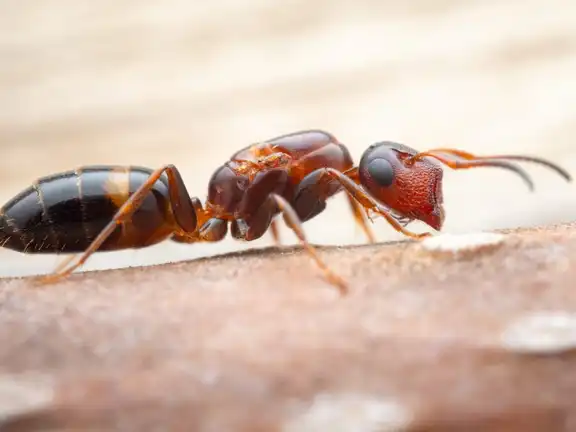
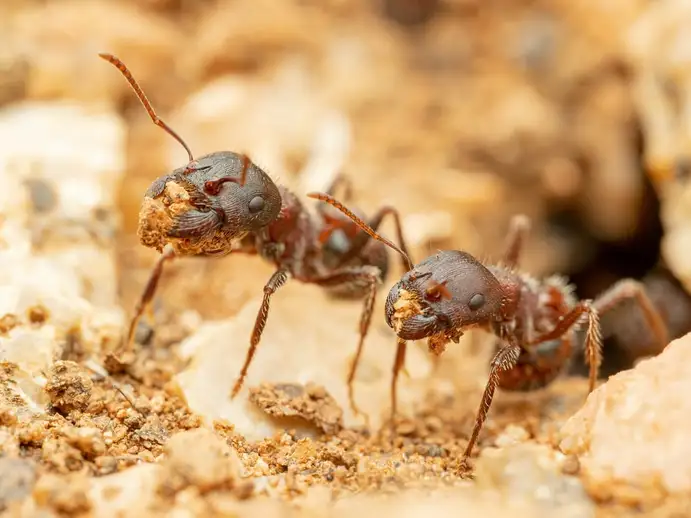
Big, heavy-built workers, reddish brown to almost black (desert populations often have a lighter, redder gaster), with coarse, wrinkled ridges on the head and thorax and a beard of long hairs under the head. Telling it from the red harvester ant Pogonomyrmex barbatus is hard even for experts, who look at how coarse the ridges on the head and thorax are, with color only as a hint.
Often confused with
- Pogonomyrmex barbatus
- Pogonomyrmex occidentalis
- Workers7–9 mm
- Queen12–14 mm
mm
Biology
- Queens
- One queenEach colony has a single queen: never put two queens together once the first workers arrive.In the glossary
- Colony founding
- Fully claustralThe queen raises her first workers without eating, living off her wing muscles and fat reserves.In the glossary
- Workers
- All the same sizeAll the workers have about the same size and shape.
- Defense
- Bites · Painful stingThe sting is very painful and can cause strong reactions: always handle the colony with care.
Native range
- North America
Mexico, United States
Taxonomy
Myrmicinae › Pogonomyrmecini
Pogonomyrmex
Care at a glance
Difficulty
Why this rating
- Makes it easier: Fully claustral: the queen needs no food until her first workers arrive
- Makes it easier: Stores seeds, so a missed feeding is not a problem
- Makes it harder: Curious workers: keep an escape barrier on the outworld
- Makes it harder: Needs a humidity gradient, with dry granaries and humid brood chambers
- Makes it harder: The workers can sting
Food
- Seeds
- Insects
- Sugar
A seed harvester: seeds can feed the whole colony, with insects and sugar as extras.
Best nests
- 1Naturalistic setup
- 2Ytong nest
- 3Acrylic nest
Notes from keepers
Tip
Seeds are the staple: offer a mix of small grass and weed seeds such as dandelion, chia, canary seed and millet, plus a few small insects each week. Keep the seed stores dry and clear out seeds that sprout or turn moldy. Sugar liquids are optional, and some keepers lost workers in them, so offer them sparingly.
Watch out
A founding queen needs no food at all, but she does need patience: she does better in sand or dirt where she can dig than in a bare tube, where some queens eat their eggs, and a young colony can stay tiny for months before it takes off. Keep it warm and undisturbed instead of tinkering.
Watch out
The sting is painful and can trigger serious allergic reactions in sensitive people, and the workers use it when the nest is opened or a lid slips. Move them with tube connectors rather than fingers, and think twice if anyone in the household is allergic to ant or wasp stings.
Tip
Heat one side of the nest only, keep the heater away from the water tube because the warmth can make it flood, and give the brood one damp chamber next to the dry seed store.
Related posts

How To Hibernate Your Ants - Hibernation Tutorial
In this guide, we’re going to talk about hibernation: What is it? Why do ants need hibernation? Should I hibernate my ants? Let's see!
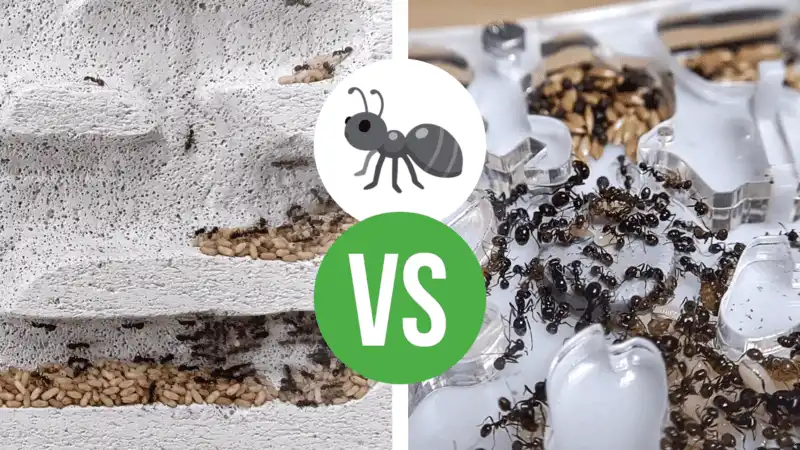
Ytong vs Acrylic - Which Is Better For An Ant Nest?
In this article, we’re going to talk about two of the most popular types of ant nests: acrylic nests and Ytong nests! Let's compare them!
How To Care for Messor barbarus
In this guide, you will learn how to care for Messor barbarus! Temperature, humidity, food, hibernation, nest type... and much more!
FAQs
10Because many of them are trophic eggs: eggs without an embryo that serve as food for the larvae. In a laboratory study, about six in ten of the eggs laid by queens were trophic, and when young larvae were given access to them only 27 percent grew into queens, against 83 percent without them. The share of trophic eggs fell after a winter rest, which is also when new queens are usually raised. So unhatched eggs in a healthy nest are not automatically a problem.
A slow start is common. One keeper had only about 15 workers after a year and called it the slowest-growing Pogonomyrmex around, another went from 8 workers to about 80 six months later after a very slow start, and a third colony grew from 8 to about 100 workers in under six months. Keepers say growth takes off with steady heat and food and that dirt-based setups do best. Brood needs about a month from egg to worker in a heated nest, so results lag behind any change you make.
A central shaft connects 12 to 15 chambers that radiate in different directions, with most of the nest in the top meter, where the seeds are stored. In southern New Mexico the deepest chambers lay in a moister layer of hardpan below the drier soil. In a laboratory study, a lone founding queen dug a nearly vertical shaft that reached about 16 cm within three days, until the bottom of the container stopped her. In captivity that translates into a dry area for the granaries and one damp chamber for the brood, and a sand or dirt setup deep enough to dig in.
Pogonomyrmex rugosus workers measure 7–9 mm, and the queen measures 12–14 mm.
Just one. Pogonomyrmex rugosus is monogyne: each colony has a single queen, so never put two queens together once the first workers arrive.
Yes, and it hurts. Pogonomyrmex rugosus workers have a very painful sting that can cause strong reactions in sensitive people, so always handle the colony with care.
In its native range, Pogonomyrmex rugosus usually flies in Jul – Sep. The weather decides the exact days.
Keep the Pogonomyrmex rugosus nest at 26–30 °C, with 50–70 % humidity in the brood chambers.
Not strictly, but it helps. A cooler winter rest at 13–16 °C, roughly during Dec – Feb, keeps Pogonomyrmex rugosus colonies healthy.
Pogonomyrmex rugosus is not on the EU list of invasive alien species and is not protected in the countries we checked. Rules differ between countries and can change, so check your local laws first.
Sources and review
- 1
- 2
- 3
- 4Mott, Gadau and Anderson (2015), Ecology and Evolution 5: Phylogeography of Pogonomyrmex barbatus and P. rugosus harvester ants with genetic and environmental caste determination (range in the USA and Mexico, how the two species are told apart, highly polyandrous queens)
Paper · Taxonomy, Biology, Distribution
- 5
Showing 5 of 39 sources
Last reviewed
- BiologyWell documented
- Care valuesKeeper consensus
- Nuptial flightsKeeper consensus
Legal status
Not on the EU list of invasive alien species and not protected in the countries we checked. Rules differ between countries and can change, so check your local laws before buying or collecting a queen.
Checked on October 11, 2026
All values are starting points: watch your colony and adjust. Found something wrong or missing?
Suggest a correction