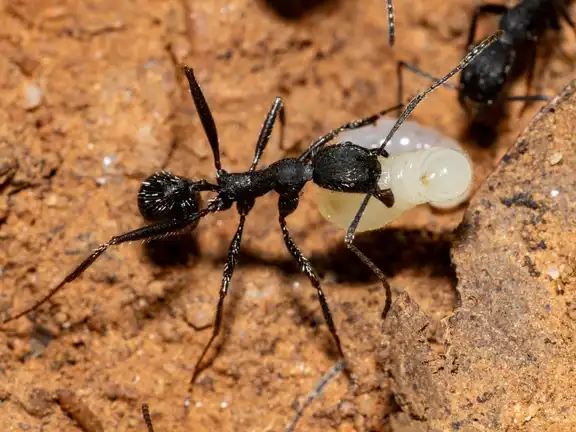
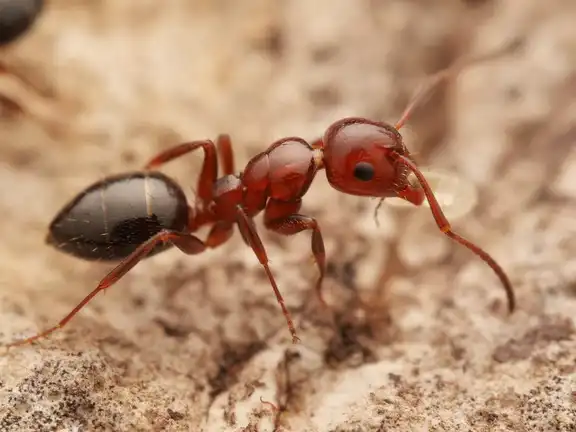
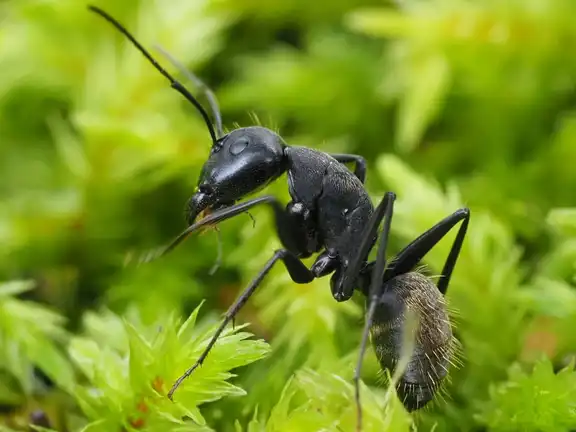
Aphaenogaster subterranea
(Latreille, 1798)
A slender, secretive forest ant that nests under stones, hunts quietly in the leaf litter and carries sweet liquids home on soaked grains of soil.
Compiled from published sources and keeper reports: I haven't kept this species myself, so treat the care values as starting points.
At a glance
- Nest temperature
- 20–26 °CIn the nest
- Nest humidity
- 50–65 %In the nest
- Hibernation
- ≈ 8–12 °CNov – Feb · recommended
- Nuptial flights
- ≈ Jul – SepEvening flights
- Workers
- 3–5 mmAll the same size
- Queen
- 7–8 mmOne queen
- Colony size
- ≈ Reaches 2,000 workersGrowth: Moderate
- Escape risk
- LowCalm ants that rarely try to escape
Year at a glance
Hibernation : Nov – Feb
Active season : Mar – Oct
Nuptial flights : Jul – Sep
- Evening flights
Months for temperate Europe and the Mediterranean. The weather decides the exact days, so flights can come earlier or later where you live.
How to recognize it
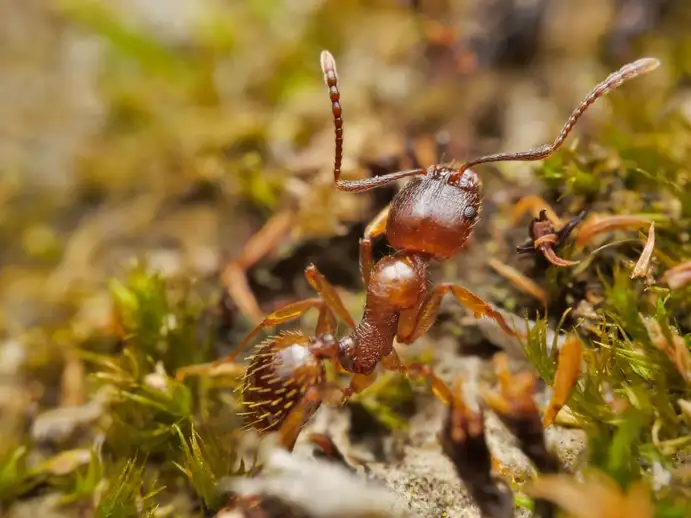
Slim, shiny, reddish-brown workers with long yellowish legs and antennae, a pair of spines on the thorax and a waist with a long stalk, like a slimmer Myrmica. The very similar Aphaenogaster ichnusa, found in the same southern European regions, has shorter, stubbier spines.
Often confused with
- Aphaenogaster ichnusa
- Tetramorium caespitum
- Pheidole pallidula
- Workers3–5 mm
- Queen7–8 mm
mm
Biology
- Queens
- One queenEach colony has a single queen: never put two queens together once the first workers arrive.In the glossary
- Colony founding
- Fully claustralThe queen raises her first workers without eating, living off her wing muscles and fat reserves.In the glossary
- Workers
- All the same sizeAll the workers have about the same size and shape.
- Defense
- Bites · StingsThe workers can sting. It is usually mild for people, but avoid handling them.
Native range
- Europe
Austria, Belgium, Bulgaria, Croatia, Czechia, France, Germany, Greece, Hungary, Italy, Romania, Slovakia, Slovenia, Spain, Switzerland
Taxonomy
Myrmicinae › Stenammini
Aphaenogaster
Care at a glance
Difficulty
Why this rating
- Makes it easier: Calm workers that rarely try to escape
- Makes it easier: Fully claustral: the queen needs no food until her first workers arrive
- Makes it harder: The workers can sting
Food
- Insects
- Sugar
Sugar or honey water for the workers, and insects as protein for the queen and the brood.
Best nests
- 1Ytong nest
- 2Naturalistic setup
- 3Sandwich nest
Notes from keepers
Tip
Be patient with a young colony: it starts slowly, and keepers report only a handful of workers after the first months, then faster growth once the colony has settled in.
Tip
The workers carry everything they find straight into the nest and cannot pass liquids mouth to mouth. Cut food into small pieces so nothing big rots inside, and put a pinch of clean sand in the nest or beside the sugar water, because they carry liquids on soaked grains.
Watch out
Do not let the whole nest dry out or swing between extremes. This is a species of damp, shady forests, and the German ant database notes that the colony develops more slowly when it is kept too dry, so keep a damp zone for the brood.
Tip
Give the shy foragers cover, such as leaf litter or bark on the floor of the outworld. They are mostly active at dusk and at night, and in the wild they hunt among dead leaves, so do not expect much activity under bright light.
Related posts
How To Make a Test Tube Setup - Ant Keeping Basics
In this tutorial you will learn how to make a test tube setup, the best way to create the optimal environment for a newly mated queen ant!

How To Hibernate Your Ants - Hibernation Tutorial
In this guide, we’re going to talk about hibernation: What is it? Why do ants need hibernation? Should I hibernate my ants? Let's see!
How To Make a Ytong Nest - Ant Keeping Tutorial
In this tutorial, you will learn how to make a Ytong nest for your ant colonies! This is one of the best nest types for many ant species!
FAQs
10Maybe not. Until 2019, Aphaenogaster ichnusa was treated as a Sardinian subspecies of A. subterranea, and the two are still mixed up. A 2023 study found both in Italy and in parts of Spain and France: ichnusa in the warm Mediterranean lowlands, and subterranea mostly higher up or in special microclimates there, but also common at sea level in continental climates. Workers differ in the shape of their spines, while queens and males can only be told apart under a microscope. Keeper sheets do not tell the two apart, so treat the care advice here as a starting point for either species until you know which one you have.
Mostly in the soil under stones, sometimes in rotten logs or leaf litter, in damp, shady broadleaf and pine forests, forest edges and hedgerows. Colonies hold from several hundred up to about two thousand workers. In Italy it is common from the lowlands up into the hills. The German ant database points out that it is on the German Red List, so wild colonies should be left alone there.
Yes. Like other Aphaenogaster, they cannot pass liquid food from mouth to mouth and have no stretchy crop, so foragers drop grains of soil, pine needles or bits of sponge into sugar water or honey and carry the soaked items to the nest. In experiments with this species and Aphaenogaster senilis, the ants favored materials that soaked up the most liquid, even artificial ones such as sponge, and only a minority of foragers did it.
Aphaenogaster subterranea workers measure 3–5 mm, and the queen measures 7–8 mm.
Just one. Aphaenogaster subterranea is monogyne: each colony has a single queen, so never put two queens together once the first workers arrive.
Yes. Aphaenogaster subterranea workers can sting. It is usually mild for people, but it's best to avoid handling them.
In temperate Europe and the Mediterranean, Aphaenogaster subterranea usually flies in Jul – Sep. The weather decides the exact days.
Keep the Aphaenogaster subterranea nest at 20–26 °C, with 50–65 % humidity in the brood chambers.
Not strictly, but it helps. A cooler winter rest at 8–12 °C, roughly during Nov – Feb, keeps Aphaenogaster subterranea colonies healthy.
Aphaenogaster subterranea is not on the EU list of invasive alien species and is not protected in the countries we checked. Rules differ between countries and can change, so check your local laws first.
Sources and review
- 1
- 2
- 3Zięcina et al. (2024), Annales Zoologici: Taxonomic revision of the Aphaenogaster subterranea species group
Paper · Taxonomy, Distribution
- 4
- 5
Showing 5 of 27 sources
Last reviewed
- BiologyWell documented
- Care valuesKeeper consensus
- Nuptial flightsKeeper consensus
Legal status
Not on the EU list of invasive alien species and not protected in the countries we checked. Rules differ between countries and can change, so check your local laws before buying or collecting a queen.
Checked on October 11, 2026
All values are starting points: watch your colony and adjust. Found something wrong or missing?
Suggest a correction